
Water activity vs moisture content in herbal pouches
A buyer’s guide to herbal-pouch water activity, moisture tests and can barriers, with worked examples, COA checks and primary technical references.
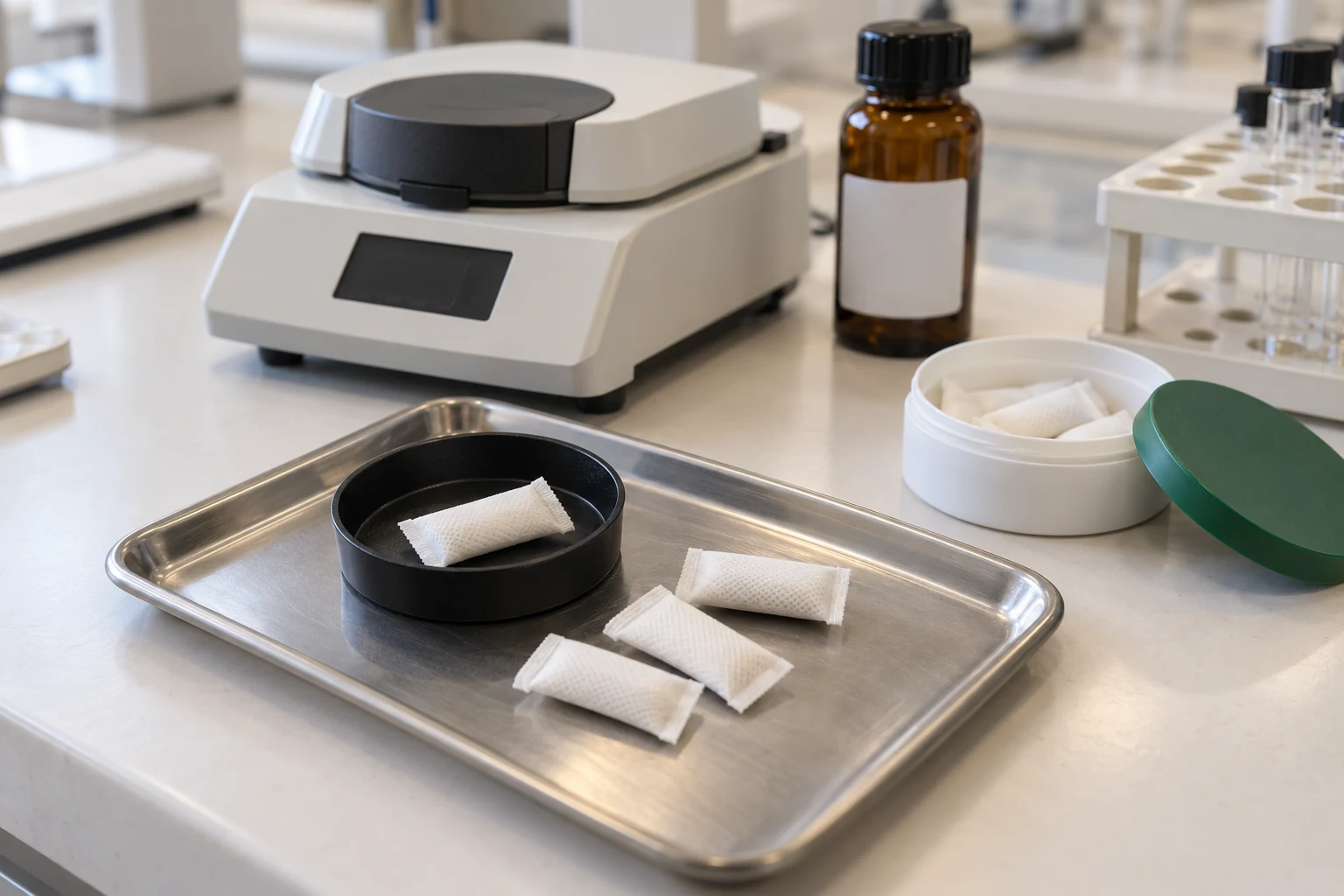
For a private label herbal pouch, specify water activity and moisture content as separate measurements. Water activity describes water’s availability in the product; moisture content describes its quantity. Neither figure, by itself, establishes the shelf life of a finished pouch in its can.
That distinction matters when comparing a dry-feeling prototype with a softer one, approving a new botanical extract, or choosing a can liner. A number copied from a different formula can hide a change in the product being purchased. The useful question is which measurements support this formula, this package and the proposed storage statement.
Water activity, moisture content and loss on drying
A supplier’s use of the word “moisture” can refer to different tests. Ask for the property and method before comparing two results.
On smaller screens, swipe or scroll the table horizontally to compare all columns.
| Measurement | What the result means | What to record |
|---|---|---|
| Water activity, aw | A dimensionless vapor-pressure ratio at a stated temperature. | Temperature, method, sample identity and instrument verification. |
| Moisture content | The amount of water relative to sample mass, on a stated basis. | Water-specific method, percentage basis and sample preparation. |
| Loss on drying, LOD | Mass lost under defined drying conditions, which can include volatile matter. | Method conditions and whether the result is suitable for this flavored formula. |
Water activity is a ratio, not a water percentage
The FDA defines water activity as the vapor pressure above a product divided by that above pure water under the same conditions. At equilibrium, aw = equilibrium relative humidity / 100. An aw of 0.60 therefore corresponds to 60% equilibrium relative humidity at that temperature. It does not mean that the pouch contains 60% water. FDA water-activity technical guide
The relationship between water content and water activity depends on the material. A moisture sorption isotherm describes that relationship at a fixed temperature. For a botanical pouch project, ask whether a change of extract, carrier or humectant needs a fresh comparison; the previous formula’s relationship should not be assumed to hold.
State the basis of a moisture percentage
Manitoba Agriculture expresses wet-basis moisture as water mass divided by the original sample mass, multiplied by 100. In a hypothetical 10 g sample containing 2 g of water and 8 g of dry material, moisture is 20% on a wet basis. It is 25% on a dry basis, because 2 / 8 × 100 = 25. These are two descriptions of the same example, not two different test results. Manitoba Agriculture moisture definitions
Write “wet basis” or “dry basis” into the specification. Also identify whether the test covers the filling, the nonwoven pouch plus filling, or a composite of several finished pouches. Results from these sample types should not be treated as interchangeable.
A flavored pouch needs a suitable drying method
USP General Chapter <731> defines loss on drying in terms of volatile matter removed under specified conditions. A drying result can therefore include substances other than water. If a formula contains volatile flavor components, ask the laboratory whether LOD answers the purchasing question, or whether a water-specific method is needed. USP <731> public preview
For example, a hypothetical 10 g sample losing 2.2 g during drying has an LOD of 22%. That calculation alone cannot establish that its water content is 22%. It also cannot determine water activity.
How to interpret water-activity numbers without inventing a limit
ISO 18787:2017 covers principles and methods for measuring water activity in food and feed across a range of 0 to 1. USP <922> describes qualification, calibration and use of water-activity meters for raw materials and products. These are method references with different scopes. An oral pouch’s classification and the suitability of a particular method still need review for its intended market. ISO 18787:2017 scope USP <922> public preview
A finished-product specification needs a justified acceptance range, a method and a rule for handling results near a limit. A laboratory should explain its measurement uncertainty and how that affects the release decision. A buying team should not create a tight limit simply because a meter displays several decimal places.
Why 0.85 is not a universal oral-pouch release criterion
The FDA’s 1984 technical guide discusses 0.85 in the regulatory context of low-acid canned and acidified foods. It does not establish a universal acceptance limit for herbal, caffeine or other functional oral pouches. A result below that figure cannot, on its own, support a safety claim, remove microbiological testing from a project, or justify a printed expiry date. FDA discussion of the 0.85 threshold
For the actual product, the quality team must consider the formula, manufacturing controls, relevant microbiological requirements and storage evidence. The same review should establish nicotine-free and tobacco-free specifications where those are part of the brief; water-activity testing does not verify either claim.
What belongs in a herbal-pouch water-activity report
A result needs enough context to be compared with the next batch. Request the following alongside the certificate of analysis:
- Product name, formula revision, batch number, manufacturing date and sampling date.
- Whether the laboratory tested filling, intact pouches or a defined composite, with the sampling plan identified.
- Test method, instrument model, sensor type and measurement temperature.
- Instrument verification records relevant to the measurement range.
- Sample handling and the laboratory’s criterion for reaching equilibrium.
- Individual results, repeat measurements where specified, acceptance criteria and any deviation.
- The laboratory’s assessment of uncertainty and the agreed decision rule.
Recording temperature is essential: water activity is temperature-dependent, and measurements at different temperatures are not directly equivalent. Keep the comparison conditions consistent when reviewing a prototype, a retained sample and a production lot. FDA guidance on measurement temperature
Check the sensor against the actual flavor system
Mint and citrus concepts deserve a method-suitability discussion when their flavor systems contain volatile compounds. AQUALAB’s instrument study describes interference in some water-activity sensors and notes that ingredient concentration and processing can change the outcome. Its results are manufacturer research on tested ingredients, not validation of a finished pouch. Ask the laboratory how it assessed your sample matrix. AQUALAB sensor-interference research
Changing the flavor can be a technical change even when the declared active amount stays the same. For caffeine pouches, the active-content assay and water-activity result answer separate questions. Both need their own suitable methods and acceptance criteria.
The can, liner and opening pattern belong in the stability plan
The complete pack includes the can body, lid, any liner or membrane, closure arrangement and intended pouch count. A prototype in a temporary sample container does not establish the performance of the final production pack.
Separate film data from whole-can evidence
Water vapor transmission rate, or WVTR, describes moisture transmission through a barrier under specified conditions. ASTM F1249-25 is a method for flexible films and sheeting; ASTM notes its relevance to packaged-product stability. Compare reports only when material thickness, temperature, humidity conditions and reporting units are clear. ASTM F1249-25 scope and significance
A film result does not describe every route through an assembled can. Ask which evidence covers the actual lid, body and seal combination. A lower film WVTR alone cannot tell you how many months a flavored pouch will remain acceptable in that package.
Use the selected can specification and packaging customization brief to identify the components being evaluated. If the liner, closure or material changes after sample approval, record the change and decide whether additional stability work is needed.
Agree what is checked during storage
Choose endpoints that fit the product: water activity, a suitable moisture measurement, relevant active-content testing, microbiological quality, flavor, appearance, pouch integrity and pack condition. Establish the schedule, storage conditions and acceptance criteria before relying on the results.
A sealed-pack study and an evaluation after repeated opening answer different questions. Define any opening pattern and handling conditions in advance. For transport, consider whether the proposed study represents expected heat and humidity exposure. Use the resulting records to support the storage statement and proposed shelf life; a fresh-sample COA cannot replace them.
The shelf-life planning guide covers the broader product brief. Water activity is one part of that assessment.
What to put in the purchase specification
For an OEM or private label herbal-pouch inquiry, send a brief that leaves the development team enough information to define the tests:
- Identify the destination market, intended adult use and product category for review.
- Name the botanical inputs, active amounts, carrier, flavor and any humectant requirements, or request custom formulation development.
- Define the pouch format, fill mass and whether each test covers filling or finished pouches.
- Identify the selected can, closure, liner and pouch count.
- Request proposed water-activity and moisture methods, sampling plans and justified acceptance criteria.
- Agree stability endpoints, pack versions, storage conditions and responsibility for approval.
- List changes that require review before the next production order.
HerbalPouches supports reference formula discussions and custom formulation briefs. Custom production starts at 3,000 cans per SKU, with at least 9,000 cans per order. Include the quantity for each flavor and can combination so testing and packaging can be discussed against the actual order.
Send the brief through the project inquiry form or email info@linkbiolabs.com. The written project specification should record which values are approved and which still require development evidence.
Frequently asked questions
Can moisture percentage be converted directly into water activity?
No universal conversion exists. The relationship depends on the material and temperature. A moisture sorption isotherm can describe a particular formulation under defined conditions; it should not be assumed to apply after a formula change.
Does water activity below 0.85 prove that herbal pouches are safe?
No. The FDA discussion of 0.85 has a specific food-regulatory context. It is not a universal oral-pouch release limit. Product-specific quality controls, relevant microbiological testing and stability evidence still need assessment.
Is loss on drying the same as water content?
Not necessarily. Loss on drying measures mass removed under specified drying conditions and can include volatile components other than water. The laboratory should confirm whether that method is suitable for the flavored pouch being tested.
Should water activity be measured on the filling or the whole pouch?
The specification must identify the sample type. Filling, intact pouches and composites are different samples. Agree the sample preparation and sampling plan before comparing results or setting an acceptance range.
Does the can affect oral-pouch shelf life?
The finished package is part of the stability assessment. Evaluate the actual can, lid, liner and closure combination with the product. A film barrier result or a result from a temporary sample container does not establish finished-can shelf life.
Can a custom herbal-pouch formula use the same testing plan as a reference formula?
It may need changes. A different botanical extract, carrier, flavor, humectant or package can affect which methods and stability checks are appropriate. Review the changes before applying the reference formula's criteria.
References and technical scope
The FDA guide supplies food-science and historical regulatory context. The ISO and ASTM links provide public scope information; the USP links are public chapter previews. Full controlled methods and their current applicability must be confirmed by the responsible laboratory. None of these references establishes approval or test performance for a HerbalPouches product.
- FDA: Water Activity (aw) in Foods
- Manitoba Agriculture: Water Content and Water Activity
- USP General Chapter <731>: Loss on Drying, public preview
- USP General Chapter <922>: Water Activity, public preview
- ISO 18787:2017: Foodstuffs, determination of water activity
- AQUALAB: Volatile ingredients and water-activity sensors
- ASTM F1249-25: Water vapor transmission through plastic film and sheeting